History as organic growth
Doctor ZhivagoHistory as organic growth is Yurii Zhivago’s analogy for the continuous, largely imperceptible transformation of society. Against accounts that make history the work of rulers or generals, it presents change as an organic process whose visible upheavals are only agents of a deeper movement—and whose apparent stillness conceals ceaseless growth.
The forest as a model of historical change
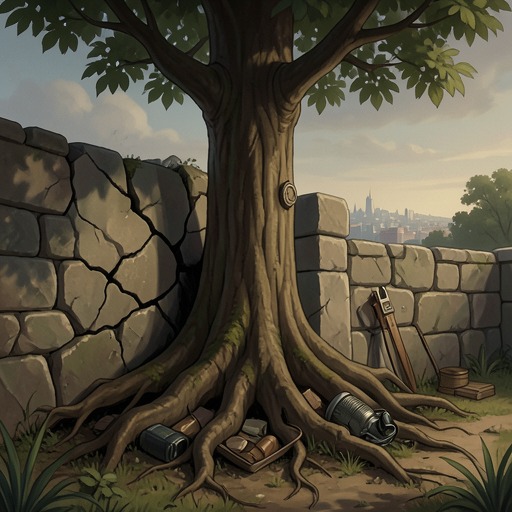
In his notes on nature and society, Yurii compares history to a forest. Under winter snow, its bare branches look thin and diminished; in a few spring days, the wood becomes leafy, expansive, and difficult to traverse. The transformation is rapid, yet its movement cannot be watched as it happens: whenever an observer looks, the forest seems motionless. Society, in this image, changes in the same way. Its life is continually transforming even when no single moment makes that transformation visible.
Individuals, upheavals, and historical agency
Yurii connects this analogy to Tolstoy’s rejection of the idea that Napoleon or another ruler sets history in motion. Tolstoy, in Yurii’s view, approached the insight without pursuing it to its full conclusion: no single person makes history. Wars and revolutions, along with kings and revolutionary leaders, are instead described as history’s organic agents, or its yeast. The image does not deny their force; it places their actions within a larger process that no individual controls.
Revolutions nonetheless have an abrupt and forceful surface. Fanatical activists, able to confine themselves to a narrow field of action, may overturn an old order in hours or days, with upheaval lasting weeks, years, or at most a few years. The spirit that animates such action can outlast the immediate event, becoming an object of worship for decades or centuries. The contrast is central to Yurii’s idea: a revolution can be swift as an episode and long-lived as an inherited fervor, while the history that contains it remains broader and less visible than either.
Memory of revolution and the life of individuals
The theory is also bound to Yurii’s mourning for Lara and for a summer in Meliuzeievo. He recalls the revolution then as a god come down to earth: a time when people went their separate ways and each life existed in its own right, rather than serving as an illustration of a thesis about the correctness of a superior policy. This remembered moment gives the organic analogy an ethical dimension. Historical life is not reducible to a program that assigns individuals a single meaning; its vitality lies in the irreducible multiplicity of lives.
Yurii’s reflections thus hold together two scales that political explanation often separates: the broad, gradual life of society and the particular lives caught within it. His forest image makes the first hard to see, while his memory of Meliuzeievo insists that the second must not be flattened into an example for doctrine. History grows beyond any one person’s direction, but its human reality is encountered in the distinct lives that resist being made subordinate to a thesis.